NYC AI Ban: New York City Restricts AI in Schools Through 8th Grade
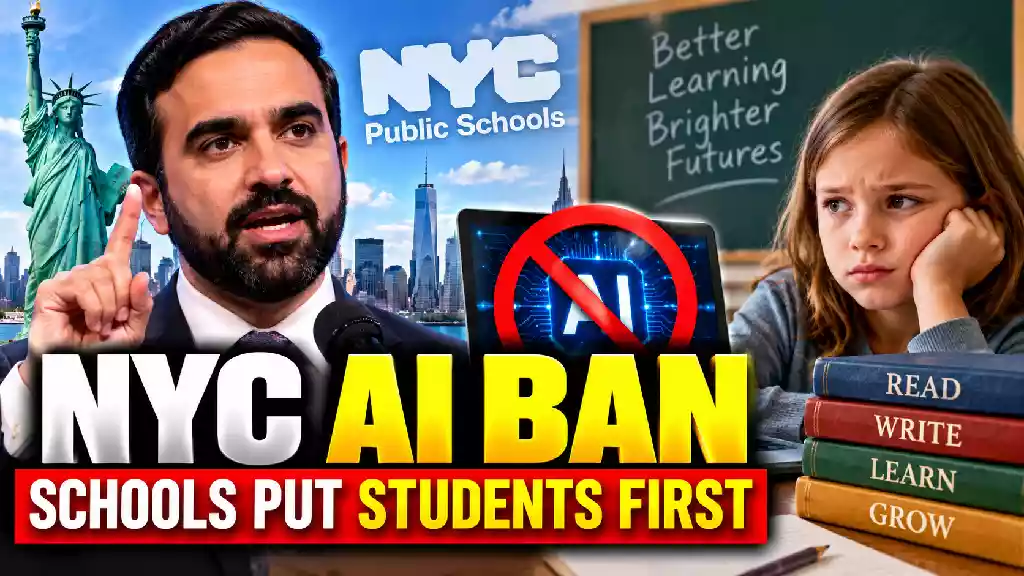
New York City’s AI restrictions for younger public school students are fueling a national debate over artificial intelligence, traditional learning, screen time, and the role of technology in education.
NYC AI Ban: New York City Restricts AI in Schools Through 8th Grade
NYC AI Ban Puts Traditional Learning Against the Technology Revolution
New York City has opened a major new chapter in the national debate over artificial intelligence and education. The city is restricting student-facing generative AI for younger public school students, putting traditional classroom learning, human interaction and emerging technology at the center of a heated discussion about how children should learn in the digital age.
The policy establishes a one-year moratorium on student-facing generative AI for students in 2-K through eighth grade during the 2026–27 school year. The move affects nearly 600,000 public school students and represents one of the broadest restrictions on student-facing AI in the country.
The decision comes as artificial intelligence rapidly becomes part of everyday life. Supporters of the policy argue that children need opportunities to develop independent thinking and fundamental academic skills before becoming heavily dependent on AI tools.
Why NYC Is Restricting AI in Schools
Mayor Zohran Mamdani’s administration has emphasized the importance of human interaction and traditional education as children develop. The discussion surrounding the policy argues that technology should not automatically be introduced simply because it is widely available.
Brendan Steinhauser, CEO of the Alliance for a Secure AI, supported restricting AI access for younger children. He argued that students are already experiencing learning losses and that excessive dependence on technology could encourage them to outsource their thinking rather than work through challenging academic material themselves.
He also highlighted traditional educational practices such as reading books, writing by hand, taking notes and communicating directly with teachers. According to his argument, those methods encourage deeper engagement with academic material and help students develop cognitive skills.
Critics Warn Against a Blanket AI Ban
Not everyone believes removing AI from classrooms is the best solution.
Erica Donalds, founder of the Education Freedom Foundation, argued that schools should take a more nuanced approach to artificial intelligence. She agreed that certain AI applications, particularly systems designed to act as children’s companions or friends, should raise serious concerns.
However, she pointed to another side of the technology debate: AI can also function as a reading tutor, math coach or supplemental educational resource for students who need additional assistance.
That creates a difficult policy question. If artificial intelligence can help a struggling student understand a lesson, should schools prohibit the technology completely, or should they establish safeguards governing when and how it can be used?
Students Are Already Using Artificial Intelligence
The challenge becomes even more complicated because young people are already finding ways to use AI outside the classroom.
The discussion cited figures showing that 70% of teenagers use AI to help with schoolwork, while 63% rely on AI for answers. At the same time, only 27% were identified as learning how to use AI safely.
Those numbers raise concerns about whether simply restricting AI at school can prevent students from becoming dependent on it.
Steinhauser argued that excessive technology use could encourage students to avoid the struggle involved in learning. He also raised concerns about technology becoming a distraction and contributing to unhealthy screen habits among young people.
The Bigger Problem: Learning and Technology
The AI debate is taking place against a backdrop of concerns about student performance.
The discussion cited a statistic that only three in 10 New York City students are proficient in reading and mathematics. Donalds argued that policymakers should focus on ensuring students have access to the strongest possible educational resources rather than assuming that technology is always harmful.
At the same time, supporters of restrictions argue that technology cannot replace the fundamentals of education. Children still need to learn how to read, write, solve problems, communicate and think critically without depending on an automated system to provide an answer.
The city is also pairing its AI policy with broader efforts to address student screen time. Official policy guidance recommends limits of 30 minutes for students in grades 3–5 and 45 minutes for students in grades 6–8.
A New Test for AI in Education
New York City’s approach could become an important test case for school districts across the United States. Other major school systems are also wrestling with questions about AI, student privacy, cheating, screen time and the potential educational benefits of new technology.
The city’s policy does not necessarily mean artificial intelligence has no future in education. Instead, it creates a period in which officials can evaluate how children interact with AI and consider what safeguards may be necessary.
The debate between traditional learning and educational technology is therefore unlikely to disappear. As AI becomes increasingly powerful, schools will have to determine how to give students the benefits of technology without allowing it to replace the human relationships and critical thinking skills that form the foundation of education.
For New York City, the AI moratorium represents a clear attempt to slow down the technology race and put children’s development first. Whether that approach ultimately strengthens student learning or deprives students of useful educational tools will be closely watched by educators, parents and policymakers nationwide
#NYCAIBan #NYCSchools #AIinEducation #ArtificialIntelligence #AI #Education #NYC #NewYorkCity #GenerativeAI #SchoolAI #EducationTechnology #AIInSchools