JD Vance Draws Line in Data Center Fight: Build the Power Too
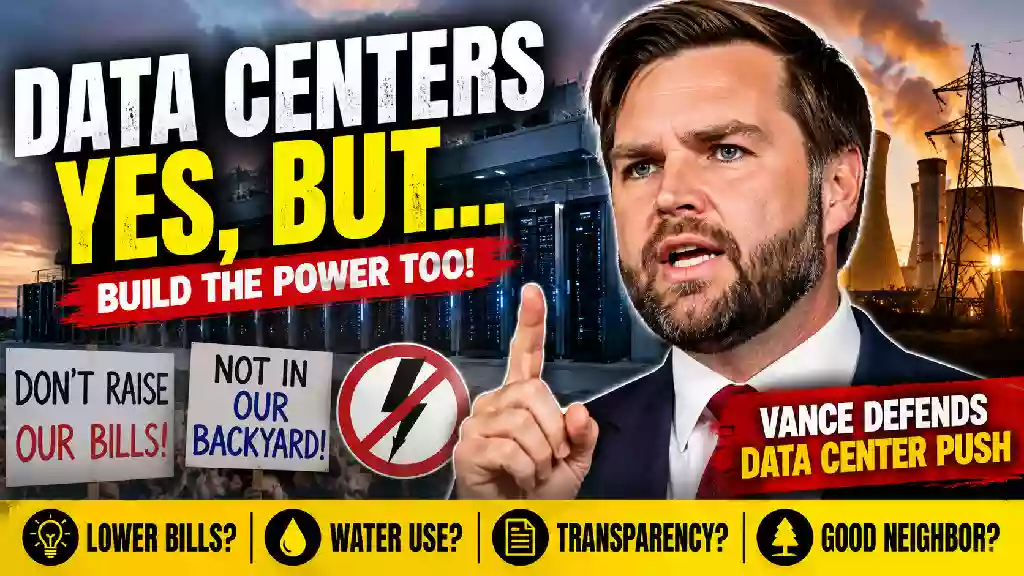
JD Vance defends data center expansion while communities question electricity costs, water use, infrastructure demands, and the impact of large AI facilities on local neighborhoods.
JD Vance Draws Line in Data Center Fight: Build the Power Too
Vice President Defends AI Infrastructure as Communities Push Back
Vice President JD Vance is defending the continued expansion of data centers across the United States, arguing that the technology infrastructure needed to power artificial intelligence and everyday digital services should not come at the expense of local residents.
The debate is becoming increasingly contentious as communities question the impact of new data centers on electricity prices, water consumption, noise and surrounding neighborhoods. Vance acknowledged that concerns are legitimate but argued that developers need to take greater responsibility for the power demands created by their projects.
His message was straightforward: if companies are going to build massive data centers, they should also help provide the power needed to operate them.
Vance Targets the Biggest Community Concern
According to Vance, much of the backlash against data centers stems from concerns that increased electricity demand could result in higher utility bills for people living nearby.
He argued that data center operators should be putting power back into the electrical grid rather than simply drawing additional electricity from it.
“If you build a data center, you should be putting power back into the grid, not taking it out,” Vance said during the discussion.
For communities already worried about energy costs, that issue could become one of the most important factors in determining whether proposed projects receive public support.
Vance suggested that data centers would be far less controversial if residents were confident that the projects would not leave them facing substantially higher electricity costs.
Theresa Payton Says Residents Have a Right to Ask Questions
Former White House chief information officer Theresa Payton acknowledged the frustration surrounding data center construction.
She said she understood why residents might not want a major data center located in their backyard. At the same time, she argued that the United States cannot afford to allow China to gain a major advantage in artificial intelligence and technology.
That creates a difficult policy challenge: America needs the infrastructure required to compete technologically, but communities also want a meaningful voice in decisions that affect their neighborhoods.
Payton argued that these objectives do not necessarily have to conflict.
Put Promises in the Contract
One of Payton’s strongest recommendations was greater transparency.
Residents, she argued, should not have to rely solely on statements made at town halls or promises contained in marketing materials. Important commitments should be written directly into contracts.
One example is electricity costs.
Could companies guarantee that local residents’ utility bills would not increase because of the data center? And could AI companies themselves assume responsibility for the additional energy costs?
Payton described that as exactly the type of question residents should be asking — and emphasized that the answer should be documented in the contract.
Water, Noise and Design Are Also Major Issues
The controversy surrounding data centers extends beyond electricity.
Communities are also raising concerns about how much water large facilities could consume, along with noise and the visual impact of enormous industrial-style buildings.
Payton pointed to Norway and Sweden as examples of places where data centers can be designed to coexist more effectively with surrounding communities.
Among the ideas discussed were water recirculation, noise suppression and maintaining significant amounts of land around facilities.
She also suggested that developers consider ways to make data centers more visually appealing, including the possibility of creating heavily landscaped areas or “vertical forests.”
Could Brownfield Sites Be the Answer?
Another proposal involves locating data centers on existing brownfield properties rather than using undeveloped land or putting facilities closer to residential communities.
The approach could allow developers to reuse sites that have already been commercially or industrially developed while potentially reducing some of the concerns associated with new construction.
Payton argued that America has an opportunity to rethink how data centers are designed and built instead of simply repeating existing models.
The Bigger Issue: America’s AI Race
Behind the local debate is a much larger national competition.
Data centers support many of the digital services Americans use every day, including online banking, online shopping and food-delivery applications. They are also critical to the development and operation of artificial intelligence systems.
That means the United States faces pressure to expand its digital infrastructure while addressing legitimate concerns from the communities hosting these facilities.
Payton argued that simply saying “no” to every project is not necessarily the answer. Instead, citizens should be equipped with better questions and stronger negotiating positions.
Can Data Centers Become Better Neighbors?
The dispute over data center expansion ultimately comes down to one question: Can America build the infrastructure it needs without forcing local communities to absorb the costs?
Vance’s position is that developers should take responsibility for the power required by their facilities. Payton’s argument goes further, calling for transparency and contractual protections covering electricity, water, noise, land use and other community concerns.
The future of America’s data center boom may depend on whether developers and policymakers can convince residents that technological progress does not have to mean sacrificing their quality of life.
#JDVance #DataCenters #AI #ArtificialIntelligence #AIInfrastructure #PowerGrid #Electricity #UtilityBills #Technology #DataCenterExpansion #TheresaPayton #USAI